
Smart Scanner
AI invoice scanner for Arabic and English invoices
AI CV screening for Arabic and English CVs
Upload a folder of CVs and every one is read, classified, and scored by AI, with each point traced to a quote from the CV.
HR teams receive hundreds of CVs per opening, many of them Arabic PDFs that most tools cannot read. Screening them by hand is slow and inconsistent, and an AI score with no explanation is not something a recruiter can trust or defend.
A full-stack, Arabic-default bilingual product. HR uploads files, folders, or ZIPs; a background worker extracts the text (repairing Arabic visual order), and n8n profiles each CV, places it in the account's own categories, and scores it on several dimensions with quoted evidence. The server verifies every quote against the CV before it can raise a score, and computes every number people sort by. On top sit filters on every profile field, Arabic and English full-text search, HR status, stars and notes, role screenings with weighted criteria and must-haves, AI summaries of any scope, CSV export, and an admin console.
Full build: product, frontend, backend, and AI workflows
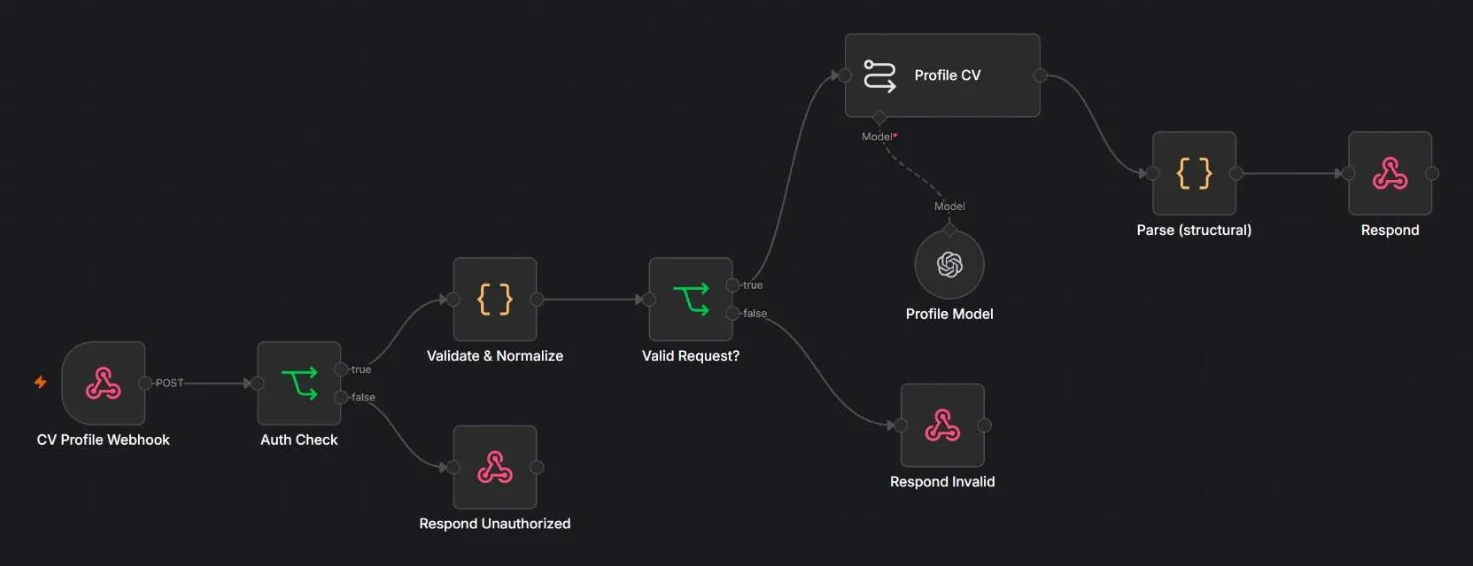
The AI engine of CV Screener: sibling agents whose tasks include profiling one CV, screening one CV against a job, and summarising a whole pool. The product server calls them; every one checks a secret first, fences the CV as data, and returns typed JSON or a typed error.
The steps are listed in the order the graph reaches them, so where the diagram splits, its branches follow one another in the list. A step that ends in a question mark is a fork: a run takes a single branch after it, as the diagram shows.
CV request webhook Webhook
Secret header check
Validate and fence
Valid request?
Profile the CV OpenAI
Reject request Webhook
Structural check
Return JSON Webhook
The diagram is drawn from the real node graph, with names simplified and nothing sensitive in it.
Hundreds of CVs become a ranked, explainable pool that a recruiter can defend.
AI invoice scanner for Arabic and English invoices
A whole website into an Excel file
Card scanner that saves to contacts
Gives an AI model real data to query
For a website, send me your LinkedIn profile, your company's current site or your shop's Google Maps listing. For automation, describe the work your team repeats by hand. I will tell you what I would build.